
Personality and Cognition: How to Work With Different Personalities in the Clinic

Clinicians must navigate various challenges in the clinic on a single day. This may include variable diagnoses, goals, and physical and cognitive abilities. Yet, sometimes it’s actually the rainbow of personalities seen throughout the day that may be the real obstacle!
Personality plays a meaningful role in how individuals approach therapy, process information, manage stressors, and engage in activities. When clinicians acknowledge and adapt to personality-driven differences, sessions can become more impactful, collaborative, and patient-centered. In this article, we’ll examine the relationship between personality and cognition and offers strategies for working with different personality styles in clinical settings.

How Personality Influences Cognitive Performance
Personality traits can affect a client’s:
- Initiation
- Response to challenges or feedback
- Frustration tolerance
- Problem-solving skills
- Emotional regulation given increased cognitive load
- Persistence with increasingly difficult tasks
For example, a highly anxious or perfectionistic client may have intact cognitive skills, but struggle with initiation or flexibility. In turn, an impulsive, novelty-seeking client may show strong processing speed but difficulty with sustained attention or self-monitoring.
Understanding these patterns helps clinicians distinguish true cognitive impairment from personality-driven performance differences.
Common Personality Styles in Clinical Settings
1. The High Achiever
Common traits:
- Goal-driven
- Competitive
- Overly self-critical
- May push themselves too hard
Cognitive considerations:
- Risk of burnout
- Difficulty tolerating errors
- Anxiety may interfere with working memory and flexibility
Clinical strategies:
- Normalize mistakes as part of learning and growth
- Emphasize process over performance
- Take reflection and self-regulation breaks
- Use objective data to show progress, not just outcomes
2. The Anxious or Cautious Client
Common traits:
- Seeks reassurance
- Hesitant to try new activities or challenges
- Fear of failure
Cognitive considerations:
- Anxiety consumes cognitive resources, impacting their ability
- Slower processing speed under stress
- Difficulty with cognitive flexibility
Clinical strategies:
- Provide clear structure, routine, and expectations
- Start with predictable, lower-demand tasks
- Use gentle encouragement rather than pressure
- Pair cognitive work with calming strategies (breathing, grounding)
3. The Reserved or Introverted Client
Common traits:
- Quiet
- Reflective
- May need more time to respond
Cognitive considerations:
- Strong internal processing
- May perform better with fewer verbal demands
- Overstimulation can reduce engagement
Clinical strategies:
- Allow extra response time
- Use visual supports or written prompts
- Avoid rapid-fire questioning
- Respect silence as thinking time
4. The Social / Talkative Client
Common traits:
- Verbally expressive
- Enjoys interaction
- May go off-topic
Cognitive considerations:
- Strong verbal reasoning
- Challenges with inhibition and task focus
Clinical strategies:
- Use structured turn-taking
- Set clear time boundaries
- Incorporate discussion into task goals
- Gently redirect without discouraging engagement
5. The Resistant or Skeptical Client
Common traits:
- Questions the value of therapy
- May appear disengaged or oppositional
- Often protecting autonomy
Cognitive considerations:
- Performance may reflect emotional stance, not ability
- Resistance can mask fear or past negative experiences
Clinical strategies:
- Collaborate on goal-setting
- Offer choices whenever possible
- Explain the “why” behind tasks
- Validate concerns without power struggles
6. The Impulsive or High-Energy Client
Common traits:
- Fast-paced
- Seeks novelty
- Difficulty slowing down
Cognitive considerations:
- Strong processing speed
- Challenges with sustained attention, inhibition, and accuracy
Clinical strategies:
- Use short, engaging tasks
- Build in movement or breaks, multi-sensory activities
- Emphasize accuracy before speed
- Teach self-monitoring strategies, ie. teach-back method
Why a Matching Approach Matters
When personality and therapy style are mismatched, clients may appear unmotivated, inattentive, or “noncompliant”. However, they may simply need a different approach.
By adapting to personality, a provider can:
- Improve engagement
- Reduce emotional overload
- Enhance cognitive performance
- Strengthen therapeutic rapport
- Support carryover into daily life
This is especially important for clients with ADHD, anxiety, brain injury, mood disorders, or executive functioning challenges.
Using Happyneuron Pro to Support Different Personality Styles
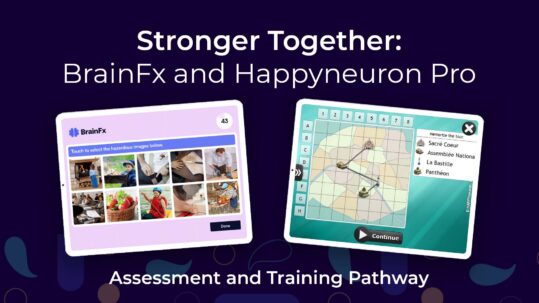
Happyneuron Pro supports personality-informed care by allowing clinicians to:
- Adjust difficulty and pacing in real time
- Choose visually engaging or more structured tasks
- Provide immediate feedback for motivated clients
- Reduce pressure for anxious clients with supportive scaffolding
- Offer variety for novelty-seeking individuals
- Track progress objectively to reinforce motivation
Because tasks can be adapted in real time, clinicians can respond to how a client presents emotionally and cognitively that day. By combining supportive therapy tools, the just-right challenge, and the therapeutic use of self, providers can adapt their approaches to client needs.
Final Thoughts
Cognition is deeply influenced by personality, emotional state, and one’s lived experiences. When clinicians take the time to understand how a client approaches tasks, rather than merely analyzing performance, we may create therapy that feels more effective and empowering. By combining clinical expertise, emotional awareness, and flexible tools, we can help clients move forward in a way that truly works for them.