
How to Use Happyneuron Pro with Aphasia After Stroke

Working with aphasia can be a daunting process. Losing the ability to communicate is frustrating, and the journey to rebuilding communication isn’t easy. During Speech-Language Pathology (SLP) month, we want to highlight the available treatment tools. Using Happyneuron Pro can help your clients build and practice their communication and comprehension skills when living with aphasia after a stroke.

What is Aphasia?
Aphasia is a language impairment that is often caused by a stroke, but can also be caused by another brain injury. Aphasia can take away someone’s ability to understand and produce spoken language, as well as to read and write. Around 25-50% of strokes result in aphasia, and around 2 million people in the United States live with it. There are multiple types of aphasia, with different severities and varied recovery.
Types of Aphasia
- Broca’s Aphasia: Individuals can understand others but struggle with using their own speech and language. They often have trouble articulating the words they want to say, writing sentences, speaking fluently, and using grammar rules.
- Wernicke’s Aphasia: Also known as fluent aphasia, in which patients struggle more with language comprehension than with verbal expression. They often have difficulty with reading and writing and may add irrelevant words into their speech.
- Global Aphasia: The most severe form of aphasia, with patients losing the ability to speak and understand language. Though people often need help with speaking and understanding words, their cognitive skills unrelated to language are usually unaffected.
- Anomic Aphasia: This milder type of aphasia causes people to struggle with word retrieval, specifically nouns and verbs. Speech comprehension is normally unaffected, but word-retrieval issues can cause them to speak vaguely or paraphrase.
- Mixed Non-Fluent: Individuals with this form struggle similarly to those with Broca’s aphasia but usually have a harder time with language comprehension. They often can read and write, but at an elementary level.
Exercises for Aphasia
Here at Happyneuron Pro, we offer digital cognitive exercises that might help providers address cognitive deficits associated with mild-to-moderate aphasia.
Embroidery
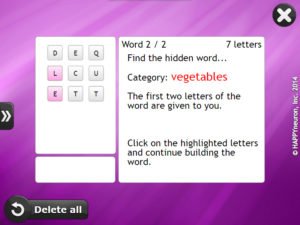
This language exercise asks your client to find a word within a letter grid. They receive a category hint and must combine this with the visible letters to identify the correct word. It enhances executive function by challenging them to plan their approach, use working memory to track connected letters, and leverage semantic memory to recall the target word’s category.
Secret Files
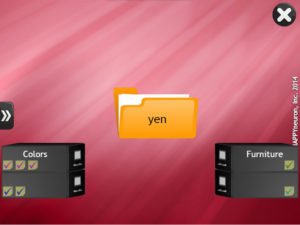
Your client will see multiple drawers and a file with a word on it. Their task is to place the word in the correct drawer, each representing a different category. Sometimes, the drawers will be unlabeled, requiring your client to use trial and error to identify the categories they represent. By accurately sorting the word files into these category drawers, your client practices semantic memory, in addition to crucial working memory skills, by identifying and remembering the categories into which words must be placed.
Split Words

This exercise focuses on word finding. After selecting a category, your client must form words from the given fragments. It’s an excellent icebreaker for group therapy sessions, as participants can collaborate to reconstruct the words. This activity helps clients improve their semantic and lexical memory and verbal fluency.
Root It Out!

This exercise focuses on word finding. After selecting a category, your client must form words from the given fragments. It’s an excellent icebreaker for group therapy sessions, as participants can collaborate to reconstruct the words. This activity helps clients improve their semantic and lexical memory and verbal fluency.
You’ve Got Voicemail
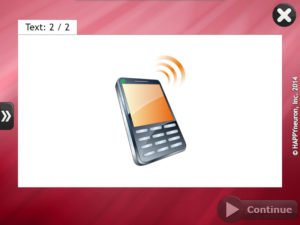
This exercise is ideal for clients who struggle with language comprehension and want to become more comfortable with social skills. During the activity, clients listen to a short voicemail and then recall its details. This helps improve their comprehension and memory skills. Additionally, you can encourage clients to paraphrase the voicemail and articulate its main idea to enhance understanding.
Hear From Happyneuron Users
Stroke Recovery Association of B.C. (SRABC) provides services, education, and advocacy to those affected by stroke throughout every stage of recovery. For clients with stroke, cognitive recovery involves learning adaptive strategies to tackle the cognitive obstacles they face. Using the various Happyneuron Pro exercises, clients with stroke can learn and practice cognitive skills across different task demands. With Happyneuron, many patients can relearn cognitive skills and recover from post-stroke symptoms.
“I found that I was building a lot of the programming myself. I would spend a lot of time in program planning trying to find the activities that I want to use. I find that HappyNeuron Pro does the work for me. It is easy to access and I like the information portion of it. “ – Karin Harrison, West Shore Stroke Recovery
The thing that I appreciate about HappyNeuron Pro is that it explains what the activity is for and what you are working on with it. There are also some videos on the website that explain what area of the brain you are working on.” – Karin Harrison, West Shore Stroke Recovery
Conclusion
Aphasia is a multifaceted condition that affects various functional living skills and one’s quality of life. Persons with aphasia and healthcare providers assisting with their care and progress may use various modalities to assist with rehabilitation and recovery. Happyneuron Pro provides another tool to address some challenges associated with aphasia and helps pave the way for progress!